





An attractive outdoor space can quickly become your favorite gathering spot. From cookouts to quiet conversation, a well-planned deck extends a home's footprint beyond the back door, increasing its value and enjoyment. Those decks, though, come at a cost. Making sure you maximize your investment will give you peace of mind when you do spend time in your outdoor space.
Most decks are made from pressure-treated wood, which has the lowest upfront cost of any material and is most widely available. Wood-plastic composites have grown steadily over the past two decades, making up about 30% of the current U.S. deck build market and are, along with other synthetics, expected to surpass wood in new deck builds within the next decade.
But are composites worth it?
How Much Does Composite Decking Cost?
Homeowners have come to appreciate composite's low-maintenance requirements, beautiful aesthetics, and long-term value.
Not all composites, though, are equal. As you research your options and compare prices between manufacturers, and even within a single manufacturer's own portfolio, be mindful of the differences that impact the varying costs of composite boards.
Most composite manufacturers offer composite decking - and railing - at different price points - a good, better, best approach. If you have an unlimited budget, perhaps a top tier decking board will appeal to you, with its extreme durability and enhanced aesthetics. But an entry-level board with durability that beats wood and appealing aesthetics may suit your needs.
When reviewing material costs, consider these factors that affect price:
- Composite material. Is it made from a wood-plastic blend or PVC (polyvinyl chloride, a combination of ethylene and chlorine)?
- Board type (capped vs uncapped; solid vs. scalloped profile)
- Board length
- Scratch Resistance
- Special technology, such as heat and fire resistance
- Availability. Is it stocked locally or does it have to be special ordered?
Deck Cost Factors
Wood and composite deck boards are sold in standard lengths, typically 8', 10', 12', 16' and 20'. Board prices, online and at lumberyard and home improvement stores, are typically calculated by lineal foot (board length), but most contractors use square footage to price bids.
When it comes to labor costs, be careful to obtain multiple quotes from contractors who are licensed and insured. While composite manufacturers all offer material calculators, those costs are estimates. Labor varies by region and can even vary widely from one contractor to another in the same locale. Interview contractors and weigh what each one brings to the project. Choosing the cheapest bid doesn't guarantee you'll be happy in the end.
Some manufacturers' websites offer contact information for contractors who have met certain requirements. They are not typically employees, but have undergone training in products and installation methods.
Composite Decking vs. Wood Cost: Is Composite Deck Worth The Money?
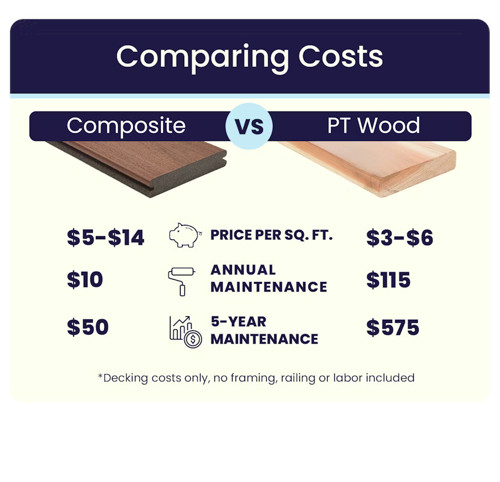
When comparing the cost of composites to wood, you may find a substantial difference in material costs up front.
For instance, the average cost per square foot for a composite deck ranges from $5-$14 per square foot for material only. Labor adds another $9-$15 per square foot on average depending upon region.
Pressure-treated lumber costs about $3-$6 per square foot, with cedar and redwood about $7-$12 per square foot. Installation costs add another $8-$14 per square foot on average depending upon region.
The initial investment for a 300-square foot pressure-treated deck, for instance, would range from $3,300-$6,000, while a composite deck would cost about $4,200-$8,700.
But composite decks quickly recoup their initial cost because they last longer, look better longer, and require far less upkeep than wood. In fact, this superior durability means the cost of a composite deck like Trex can be offset easily over time.
Compared to natural wood decks, which may last only 15 years with diligent maintenance, composite decks last 25 to 50 years. That's due to the mixture of synthetic and organic fibers that are wrapped in a protective synthetic shell, that make the boards highly durable.
Composites resist splintering, rotting, and insect damage, and come with warranties lasting 25 to 50 years. These benefits, along with a growing focus on sustainability and low-maintenance living, continue to drive the building of decks away from wood and toward composites.
Comparing Prices of Composite Decking Brands
When comparing composites, limit your search to companies that have a current engineering report. Many building officials won’t issue a building permit without an engineering report. Reports summarize test results of the manufacturers' products.
Another important factor to consider is material availability. It’s best to find composite decking stocked by a lumberyard or another retailer in your area. This make shipping, returns and future purchases more convenient.
Comparing prices is important to ensure you get the best product that meets your budget. Consult manufacturers’ websites and visit your local distributor or retailer to see how price relates to appearance and performance.
In most cases, you should also be able to pick up samples of composite decking materials from your local lumberyard or dealer or order them online. It’s a good idea to do some practical testing at home to see how the board color works in your environment. You may also want to test the board's scratch resistance and durable properties.
Some materials tend to fade more than others. If your deck will be subject to intense sun and little shade, look for a finished project or outdoor display that has been exposed to the elements for a few years. Compare its deck boards with new ones to see how well they have resisted fading.
Check out our comprehensive composite decking comparison pricing chart for the most popular brands available, including the average cost of Trex decking. Trex's low-maintenance decks cost roughly two to five times more than wood, depending on the performance tier which ranges from entry-level to luxury, but they last for decades and offer a lower total cost of ownership over their lifetime.
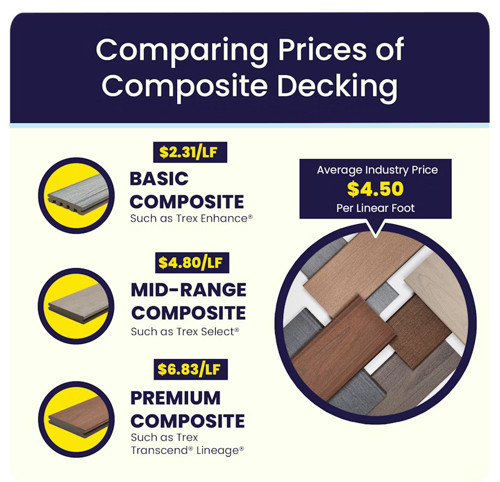
Composite Decking Brand Price Comparison Chart
Brand | Cost Per Linear Foot | Code Compliance Report |
$4.71 | ||
$7.25 | ||
$5.15 | ||
$4.70 | ||
$7.00 | ||
$6.00 | ||
$5.50 | ||
$5.75 | ||
$5.00 | ||
$6.00 | ||
$2.31 | ||
$3.15 | ||
$4.80 | ||
$6.83 | ||
$3.50 | ||
$7.75 | ||
$3.50 | ||
$7.25 |
| |
$10.50 | UES-367 |
Cost to Replace Deck Boards with Composite
The cost to replace wood deck boards with composite can run between $15 to $25 per square foot. A variety of factors may impact this range in costs, including the cost of composite materials, size of the deck, the complexity of the deck’s shape or patterns to lay the decking, and the cost of labor. If you plan to install new composite decking yourself, the costs may range between $8 and $22 per square foot.
Due to the upkeep required by wood decking, many homeowners decide to later remove wooden deck boards and replace them with lower-maintenance composite decking. It’s possible to just replace wood decking with composite, but if your deck’s original structure and framing materials are made from wood, remember that you'll want to ensure its structurally sound and the joists aren’t rotted. Typically, it’s not recommended to only replace the boards.
Get started by calculating the cost to build your deck here.
When you’re ready to build your deck, find a contractor near you or find a retailer to buy composite decking.


